What is Twin²Sim?
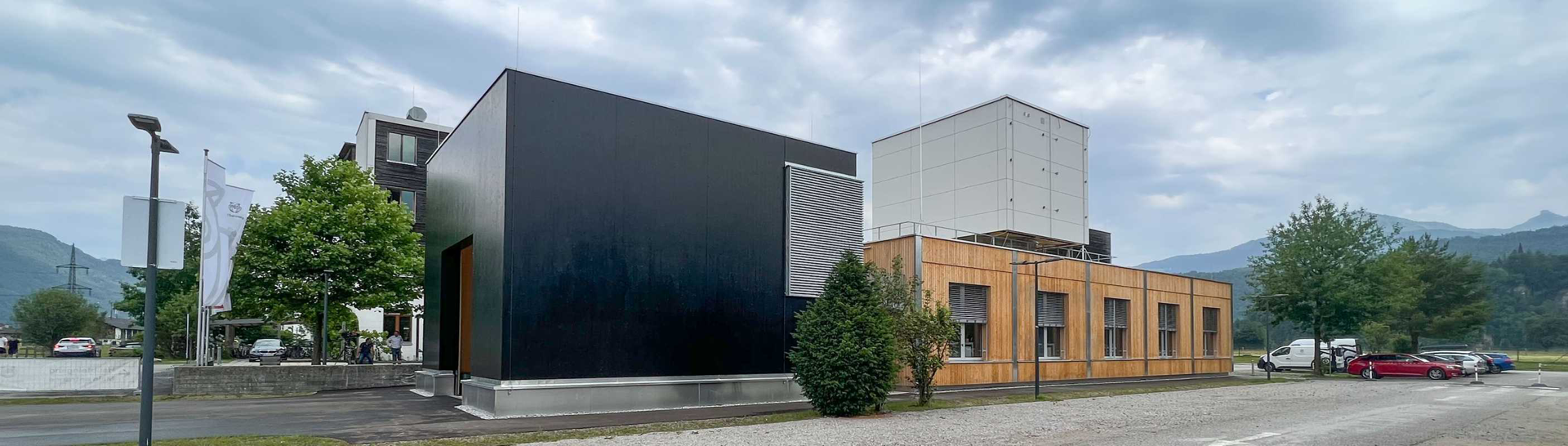
Twin²Sim is an experimental building operated by Salzburg University of Applied Sciences at the Kuchl campus. Twin²Sim consists of a building-envelope test rig, an experimental building, and a handling hall.
Twin²Sim: Multifunctional Test Rig
The project enables holistic investigation of complex building envelopes and building services through a multifunctional façade test rig (short-term investigations of 3 to 9 months) and an experimental building, where previously characterized façade components, as well as building services systems, can be evaluated over the longer term (more than 9 months) in interaction with the room and its users. Following measurements, simulation and model development enable further development using the digital twin, helping reduce future development costs by reducing the need for physical prototypes. For only the second time in Austria, the facility allows measurement of the sound reduction index of components in a timber-construction test rig, and for the first time it also allows measurement of flanking transmission. This capability is particularly significant for the development of lightweight (timber) components, because no calculation methods are available for such components and simulation is still limited to research applications.
Increasingly complex systems require complex multiphysics investigations and equally complex simulation models, which test rigs based on standardized methods can only support to a limited extent. Such methods aim to isolate a single phenomenon rather than analyze multiple phenomena in the same test, or at least on the same physical test setup or prototype. Twin²Sim supports multiphysics investigation and research to examine the behavior of building services systems and components, building-envelope components, multifunctional building envelopes, and the associated monitoring, control, and automation. Multifunctional building envelopes include building services components, for example for energy generation or ventilation.
The applications include new construction, densification, and renovations. In existing buildings as well, prefabricated façades can quickly improve energy performance and support a switch to renewable energy.
© LP architektur ZT GmbH/FH Salzburg
Simulation on the Digital Twin
Drawing on the centres’ expertise, building components and systems are represented using suitable models and simulations in building services and plant engineering. Subsequent development steps can then be modeled using these digital twins. This approach does not replace standardized tests, but it can eliminate the need to repeat them multiple times during development. Twin²Sim is used in funded research projects and in contract research.
Technical Data
You can find information on technical data and measurement equipment here.
Building Envelope Test Rig
The test rig is a small, separate building of mass timber construction on the roof of the experimental building. It consists of a technical room and two test rooms (the “Twins”), both of which feature a fully replaceable façade (the test field). The rooms are separated by a high-performance acoustic partition wall.
The test rig’s building envelope provides very high performance in terms of thermal insulation (U << 0.1 W/m²K), airtightness (n50 << 0.3 h-1), and sound insulation, and it is clad with a white fiber-cement façade to reduce the effects of solar radiation. The outer enclosure of the two test rooms is heated and cooled on two levels: the outer level creates quasi-adiabatic conditions, and the inner level supports precise control of room temperature. The two test fields can be coupled. Measurements are taken relative to outdoor conditions.
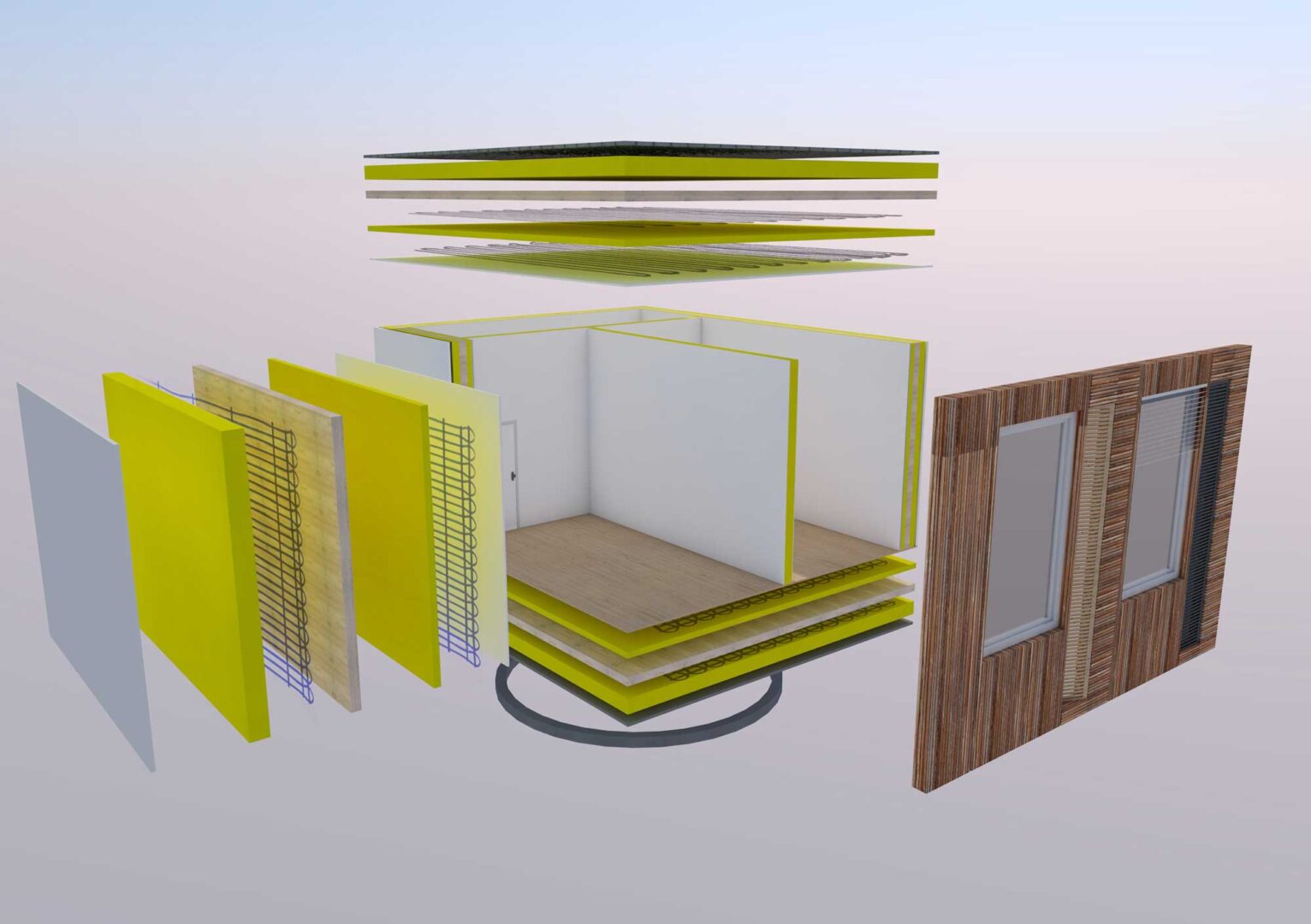
The test rig requires very stable temperature conditions in order to assess the influence of the test specimens on the room. For this reason, all exterior surfaces are heated or cooled on two levels, and the energy used for this is measured. In addition, temperature, humidity, heat flux, solar radiation, wind, and, if required, other physical parameters are recorded outdoors and indoors, as well as on the components themselves.
© FH Salzburg
The test rig on the roof of the experimental building is rotatable and can track the sun, allowing different solar exposure to be captured over the sun’s path even within a comparatively short investigation period of a few weeks to months.
The test rig supports investigations of comfort, sound reduction index and flanking transmission, thermal and moisture performance, TABS, airflow and ventilation, daylight and artificial lighting, and integrated building services supplied from the test rig.
| Example Investigation Objectives | Test Design |
| Comfort | Measurements of room conditions using thermal comfort probes under changing outdoor conditions and changing conditions of the test specimen and the integrated building services components |
| Thermal & Moisture Performance | Measurements of temperatures, heat flux, material and air humidity at the component and within component layers, as well as thermo-hygrometric room conditions, under changing outdoor conditions and changing conditions of the test specimen and the integrated building services components |
| TABS | Measurements of temperatures, heat flux, and fluid mass flow at the component and within component layers, as well as thermo-hygrometric room conditions, under changing outdoor conditions and changing conditions of the test specimen and the integrated building services components. Implementation of control strategies for energy-flexible operation. |
| Airflow & Ventilation | Measurements of thermo-hygrometric room conditions using thermal comfort probes, as well as measurements of airflow at and within components or within building services systems |
| Daylight & Artificial Lighting | Measurements of radiative parameters (illuminance distribution, global solar radiation distribution), temperatures, and heat flux at the component and within component layers, under changing outdoor conditions and changing conditions of the test specimen and the integrated building services components |
| Sound Insulation & Flanking Transmission | Measurements of the in-situ sound reduction index of components in the test field, as well as flanking transmission through the test specimen from one test room to the next |
| All investigations are carried out with continuous recording of the environmental conditions relevant to the test, and all data are captured in a database and stored for at least five years. | |
| Investigations are not limited to the examples listed; they can be flexibly adapted to the specific research question. | |
| Due to the construction type and rotatability, the weight of test specimens is limited to 1,250 kg/m. | |
Experimental Building
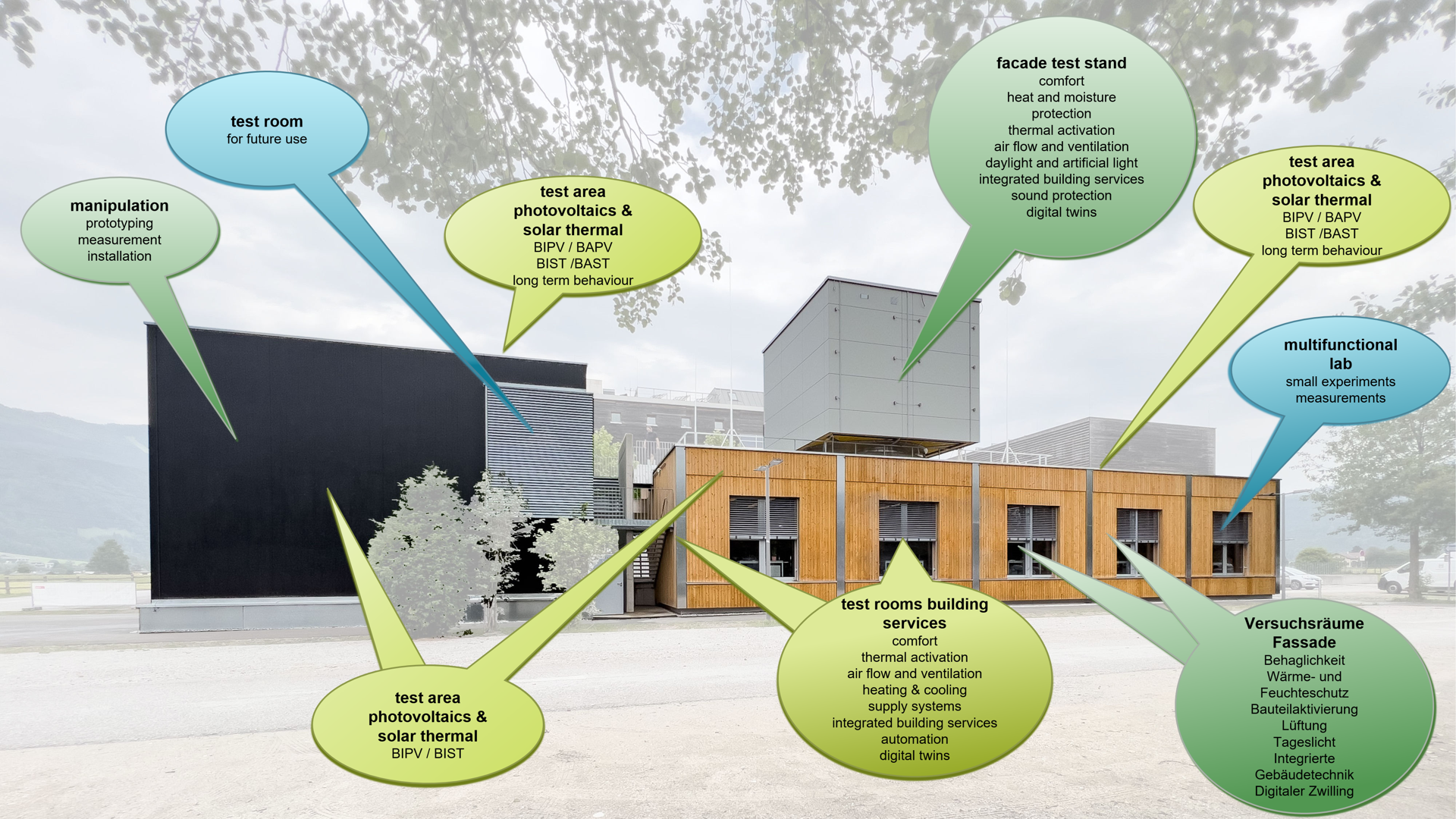
The experimental building is used as an office building and includes four test rooms and a multifunction lab.
Two test rooms primarily support investigations of building services systems and their effects on people and space. Investigation objectives include comfort, TABS, airflow and ventilation, heating and cooling, different delivery systems such as thermally active components made of concrete and mass timber, integrated building services, and automation.
In the other two test rooms, the façades can be fully dismantled and replaced with façades that match the dimensions used at the test rig. Here, test specimens can be investigated over longer periods and in interaction with the room.
A fifth room serves as a multifunction lab for small-scale tests and measurements on small prototypes or devices.
| Example Investigation Objectives | Test Design |
| Comfort | Measurements of room conditions using thermal comfort probes under changing outdoor conditions and changing conditions of the test specimen and/or the integrated building services components; thermal, hygric, and visual comfort parameters are examined |
| Energy Flexibility | Investigation of control algorithms for energy-flexible operation using different signals (electricity price signal, PV, wind power, …) |
| Overall Energy Efficiency: Blinds | Measurement of how blind position and control affect the energy demand for heating, cooling, and lighting |
| Overall Energy Efficiency: Ventilation | Measurement of how ventilation and ventilation control affect heating and cooling energy demand as a function of different heat delivery systems (TABS in walls and/or ceilings, underfloor convectors, heating and cooling walls) |
| Overall Energy Efficiency: Supply Systems | Measurement of how different heating and cooling terminal systems and their control affect heating and cooling energy demand (TABS in walls and/or ceilings, underfloor convectors, heating and cooling walls) |
Multifunctional Lab
| Example Investigation Objectives | Test Design |
| Small-Scale Tests and Prototypes | Tests and measurement series on small prototypes, especially to prepare large-format prototypes and/or long-term investigations |
| Use as Living Space | The lab can be converted into a bedroom or living space, and the room height can be reduced by installing suspended ceilings. This makes it possible to investigate a simulated residential use in a practical way in addition to office use. |
| Comfort | Measurements of room conditions using thermal comfort probes under changing outdoor conditions and changing conditions of the test specimen and the integrated building services components |
| Roof Areas Office Building | |
| Elevated PV Arrays | Investigation of performance and yield under changing outdoor conditions, for example in combination with simulated retention (evaporative cooling) through the installation of retention trays |
| Elevated Solar Thermal | Investigation of performance and yield under changing outdoor conditions, for example in combination with changing loads, TABS in concrete and mass timber, and buffer storage tanks |
| Elevated Solar Thermal | Use for heat recooling under changing outdoor conditions |
| Plate-Shaped Components or Components Applied to Plates | Aging behavior and weathering |
| Façade Areas Office Building | |
| Façade Components of Rear Ventilated Façades | Aging behavior and weathering |
| Façade Components of Rear Ventilated Façades | Impact on the assembly (heat and moisture) and the indoor space |
| Building-Integrated Photovoltaics | Investigation of performance and yield under changing outdoor conditions, as well as impact on the assembly (heat and moisture) and the indoor space |
| Building-Integrated Solar Thermal | Investigation of performance and yield under changing outdoor conditions, as well as impact on the assembly (heat and moisture) and the indoor space |
Façade and Roof Areas
On the south façade of the experimental building, the entire façade cladding is demountable and can be replaced with test specimens such as photovoltaics or solar thermal, or used flexibly as a ventilated façade for weathering tests, for example. This provides an additional approximately 65 m² of test area, excluding the test fields. Provisions are in place for easy connection of measurement and instrumentation technology.
The east, west, and south façades of the handling hall can be fitted with test specimens that are not intended to have a heated volume behind them. A total of approximately 180 m² is available for such tests.
On the roof of the office building, a gravel-covered area supports outdoor tests of many different kinds. Provisions are in place for easy connection of measurement technology.
Handling Building
The handling building includes a small assembly hall, a tool storage area, one technical room on the ground floor and one on the upper floor, and a storage area on the upper floor.
In the handling hall, prototypes are built or externally delivered prototypes are fitted with measurement technology.
The handling hall supports the construction and preparation of test objects (test specimens) and serves as storage space for test objects and prototypes.
| Plate-Shaped Components or Components Applied to Plates | Aging behavior and weathering |
| Building-Integrated Photovoltaics | Investigation of performance and yield under changing outdoor conditions, as well as impact on the assembly (heat and moisture) and the indoor space |
| Building-Integrated Solar Thermal | Investigation of performance and yield under changing outdoor conditions, as well as impact on the assembly (heat and moisture) and the indoor space |
| All investigations are carried out with continuous recording of the environmental conditions relevant to the test, and all data are captured in a database and stored for at least five years. | |
| Investigations are not limited to the examples listed; they can be flexibly adapted to the specific research question. | |
| Due to the construction type, the weight of test specimens may be limited. | |
Catalyst for R&D and Industry
The facility serves as an enabling platform for R&D and industry, especially for SMEs without their own research facilities, and it is available to companies without discrimination, for example as part of collaborative research projects.
Funding and Sponsorship

The project was funded by the State of Salzburg under WISS2025.
In addition to funding from the State of Salzburg, we were able to secure a number of
Sponsors who supported us through discounts and/or in-kind contributions.