Our methods provide the essential overarching approach to investigation and problem-solving, alongside tools such as specialized software and lab equipment.
Research and development require methods: research to prove or disprove hypotheses, and development to create solutions, products, and services. We continually adopt new methods based on existing expertise and on the current state of the art, aligned with the research or development questions at hand. As a result, our methods portfolio is highly dynamic. The overview below describes our current standard methods:
Energy Systems
Building simulation for modeling and analyzing building envelopes and building services at a wide range of levels of detail
Building energy use
Impact of different materials
Comfort
Summer overheating
Energy Flexibility
Monitoring and data science
Collection of measurement data, taking measurement errors and confounding variables into account
Analysis of measurement data, including pseudonymization when needed
Digital twins (simulation models) of buildings, technical installations, and their system components
Model validation with measurement data
Data science methods
Automated generation of simulation models
Analysis of large datasets from simulation and measurement using artificial intelligence methods
Fault detection and analysis
Maintenance information
Analysis of fluid flows using CFD simulation
Prototype and test planning for physical and virtual prototypes (digital twins) for experimental investigations in the Twin²Sim experimental building with its façade test rig
Building Envelopes and Building Systems
Systematic, criteria-based analyses and comparisons for (multifunctional) building and building-envelope systems
Requirements-oriented, principle-based system development for (multifunctional) building and building-envelope systems
Variant development and parametrization for (multifunctional) building and building-envelope systems
Hygrothermal and thermal building-component simulation (2D, 3D in development)
Mechanical FEM analyses of small building components (in development)
Development and design of (multifunctional) building and building-envelope systems
Analysis of functional and structural parameters for the systematic development of building components and construction details for parametric 2D and 3D digital models
Building and building-envelope system development
Prototype and test planning for physical and virtual prototypes (digital twins) for experimental investigations in the Twin²Sim experimental building with its façade test rig
Settlement Systems
Applied Geographic Information Systems (GIS) processing and modeling
3D and 4D geospatial data infrastructures, data standardization, and data harmonization
Development of spatial indicators
Development of technology-based planning tools
Cartographic visualization, 3D and 4D visualization (web cartography, dashboards), and web application development
Interactive data visualization: dynamic data queries and charts
Living Lab Twin²Sim and Equipment
Living Lab Twin²Sim
Twin²Sim is an experimental building operated by Salzburg University of Applied Sciences at the Kuchl campus. It consists of a building-envelope test rig, an experimental building, and a handling hall.
The test rig supports holistic multiphysics analysis of building envelopes and building services. Short-term investigations (3 to 9 months) at the building-envelope test rig can be combined with long-term investigations of the same prototypes in the experimental building.
The experimental building also serves as an office building and includes four test rooms and a multifunction lab. Two test rooms primarily support investigations of building services systems and their effects on people and space. In the other two test rooms, we can fully dismantle and replace the façades with units that match the dimensions used at the test rig. This allows test specimens to be examined over longer periods (several years) in interaction with space and its users.
A fifth room serves as a multifunction lab for small-scale tests and measurements on small prototypes or devices.
More information about Twin²Sim is available here:
Scientific Software
Building Physics
GEQ (energy performance certificate software)
WUFI 2D (hygrothermal simulation)
HTflux (building-physics software for high-resolution 2D simulations of heat and moisture transport)
Mechanics
Autodesk Inventor (in development)
Life Cycle Assessment
openLCA
Building Simulation
IDA Indoor Climate and Energy (IDA ICE) (detailed, dynamic, multi-zone simulations of indoor climate and whole-building energy use)
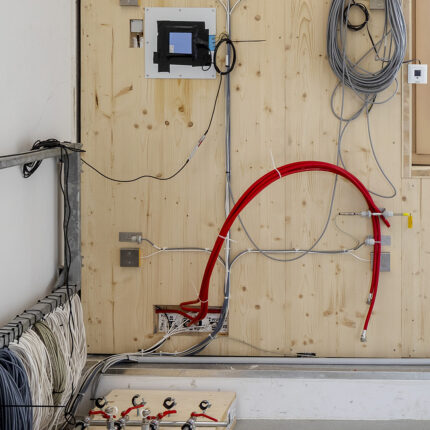
Measurement kits for capturing digital and analog signals with integration into the central measurement database
Almemo measurement devices with integration into the central measurement database
Testo measurement devices
Calibrated Fluke multimeters
Gossen calibrator for voltage, current, and resistance values
Sensors for radiation; heat flux; air, fluid, and surface temperature; air, material, and surface humidity; flow; displacement and deformation, current, and voltage
Thermal imaging cameras
Monitoring:
Detaillierte Monitoring-Systeme auch mit kundenspezifischen Regelungsstrategien
Calibration:
Wet- and dry-block calibrator for temperature sensors and the temperature sensor in combination probes
Calibration of humidity probes and humidity sensors in combination probes in climate chambers, and heat-flux sensors on a plate heater (in collaboration with the Department of Design and Green Engineering at Salzburg University of Applied Sciences)
Lab and Handling
Lab
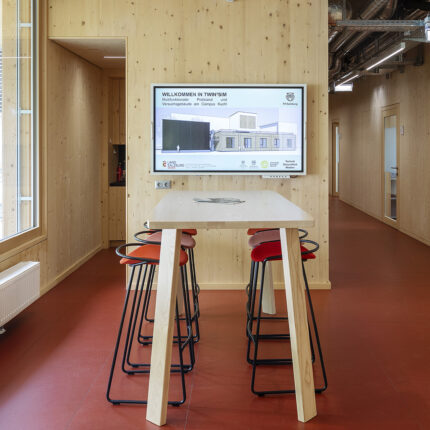
Integrated into our Living Lab Twin²Sim is a small multifunctional lab for small-scale preliminary tests, for calibrating and function-testing sensors, and for preparing experiments. Two lab benches provide the working environment. For larger reconfigurations in building-integrated monitoring, control, and automation, as well as for field installations, programming tasks can be carried out individually or in groups. For group work, including with external partners, the space provides appropriate communications equipment, including a room camera and microphones and a large-format display.
Handling
Storage areas in the lab and on the first floor of the handling building are essential not only for measurement equipment and supporting tools, but also for storing small prototypes, measurement distribution boxes, and similar items that may be needed again during the scientific evaluation of experiments. In the handling hall within Living Lab Twin²Sim, larger tests are prepared or carried out. It primarily serves as a workspace and storage area for large building-envelope prototypes (test specimens), for installing and function-testing monitoring, control, and automation equipment before mounting it at the test rig, for removing installations after disassembly, and for partial dismantling of prototypes, especially for subsequent damage inspections.