Download link for the timber construction system with registration
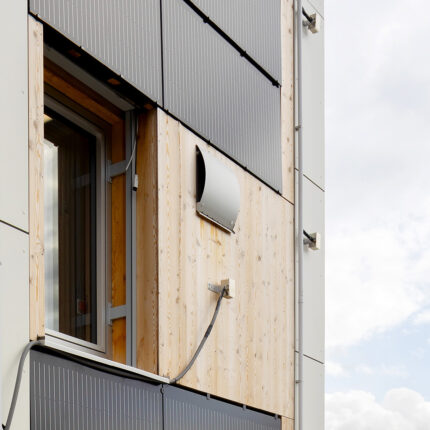
The center offers a free timber construction system for the vertical densification of multi-story residential buildings from the 1950s to the 1970s. The system includes a component catalog, construction details, preliminary structural calculations, and a system manual.
Bridging the renovation data gap: A novel method for estimating renovation activity and rates from energy performance certificates Heidenthaler, D., Leeb, M., & Löffler, G. (2026). Bridging the renovation data gap: A novel method for estimating renovation activity and rates from energy performance certificates. Energy and Buildings. https://doi.org/10.1016/j.enbuild.2025.116892https://pure.fh-salzburg.ac.at/en/publications/bridging-the-renovation-data-gap-a-novel-method-for-estimating-re/
Using Co-Simulation to Capture Sector Coupling Dynamics in Low-Temperature Anergy Systems. Vereno, D., Lugmair, M., Gross, J.-A., Leeb, M., & Neureiter, C. (im Druck). Using Co-Simulation to Capture Sector Coupling Dynamics in Low-Temperature Anergy Systems. In IEEE Green Technologies Conference (GreenTech) 2025 IEEE Power & Energy Society. https://pure.fh-salzburg.ac.at/en/publications/using-co-simulation-to-capture-sector-coupling-dynamics-in-low-te/ Options for reusable designs: with a focus […]
Trends in energy performance certificate data: A comparative study of building stock characteristics. Heidenthaler, D., & Leeb, M. (2024). Trends in energy performance certificate data: A comparative study of building stock characteristics. In BauSim Conference Proceedings https://doi.org/10.26868/29761662.2024.37 https://pure.fh-salzburg.ac.at/en/publications/trends-in-energy-performance-certificate-data-a-comparative-study/ The strategic realignment of research at the Salzburg University of Applied Sciences as part of an organizational […]
Automated energy performance certificate based urban building energy modelling approach for predicting heat load profiles of districts. Heidenthaler, D., Deng, Y., Leeb, M., Grobbauer, M., Kranzl, L., Seiwald, L., Mascherbauer, P., Reindl, P., & Bednar, T. (2023). Automated energy performance certificate based urban building energy modelling approach for predicting heat load profiles of districts. Energy, […]
Continuing to build on existing structures, affordable housing, and climate protection—an example. Eitzinger-Lange, L., Gugg, B., Leeb, M., Lüftenegger, P., Mair am Tinkhof, O., Wieder, E., & Fuchshofer, R. (2022). Continuing to build on existing structures, affordable housing, and climate protection—an example. In Renovated buildings in good company: BauZ! Vienna Congress for Sustainable Building (Volume […]
Comparative analysis of thermally activated building systems in wooden and concrete structures regarding functionality and energy storage on a simulation-based approach. Heidenthaler, D., Leeb, M., Schnabel, T., & Huber, H. (2021). Comparative analysis of thermally activated building systems in wooden and concrete structures regarding functionality and energy storage on a simulation-based approach. Energy, 233. https://doi.org/10.1016/j.energy.2021.121138 […]
Simulation Model for Minimal Invasive Refurbishment Approaches Through Prefabricated Multifunctional Radiant Heating Façade Elements. Bayer, M., Karnutsch, M., Grobbauer, M., Gnigler, M., & Leeb, M. (2019). Simulation Model for Minimal Invasive Refurbishment Approaches Through Prefabricated Multifunctional Radiant Heating Façade Elements. In Proceedings of Building Simulation 2019: 16th Conference of IBPSA (S. 1770-1777). (Building Simulation Conference […]
Our prototypes to date include solutions and tools for a wide range of questions: Read more here. Get in touch with our Centre Leadership or the Working Group Leads.
We are happy to advise you on whether your idea is eligible for funding and in what form, and to support you in finding suitable research and industry partners.
Our methods provide the essential overarching approach to investigation and problem-solving, alongside tools such as specialized software and lab equipment.
Zentrum Alpines Bauen 2018–2022. Interdisciplinary Contributions to Building Densification
From 2018 to 2022, the Alpine Construction Research and Transfer Center focused on three interdisciplinary research areas: energy and resource optimization, climate-adapted construction, and, as a central cross-cutting issue, redensification as a contribution to the internal development of settlement areas and as a lever for increasing added value and thus financing building renovation. The focus of the content was determined with the involvement of relevant regional strategies. The project partners were the Salzburg University of Applied Sciences with the Smart Building and Smart City research area as consortium leader and Research Studios Austria Forschungsgesellschaft mbH with the Research Studio iSPACE Smart Settlement Systems as cooperation partner. The research and transfer activities were accompanied by a nine-member project advisory board with representatives from interest groups and public administration.
The publication summarizes the results and prototypes from this first funding period of the Center for Alpine Construction.
Download link for the timber construction system with registration
The center offers a free timber construction system for the vertical densification of multi-story residential buildings from the 1950s to the 1970s. The system includes a component catalog, construction details, preliminary structural calculations, and a system manual.
Publications 2026
Bridging the renovation data gap: A novel method for estimating renovation activity and rates from energy performance certificates
Heidenthaler, D., Leeb, M., & Löffler, G. (2026). Bridging the renovation data gap: A novel method for estimating renovation activity and rates from energy performance certificates. Energy and Buildings.
Using Co-Simulation to Capture Sector Coupling Dynamics in Low-Temperature Anergy Systems.
Vereno, D., Lugmair, M., Gross, J.-A., Leeb, M., & Neureiter, C. (im Druck). Using Co-Simulation to Capture Sector Coupling Dynamics in Low-Temperature Anergy Systems. In IEEE Green Technologies Conference (GreenTech) 2025 IEEE Power & Energy Society.
Options for reusable designs: with a focus on buildings with short useful lives.
Kindelbacher, S., & Dorsch, L. (2025). Options for reusable designs: with a focus on buildings with short useful lives. In Continue building? How do you do that? : Conference proceedings 2025 (p. 5). IBO Verlag.
Trends in energy performance certificate data: A comparative study of building stock characteristics.
Heidenthaler, D., & Leeb, M. (2024). Trends in energy performance certificate data: A comparative study of building stock characteristics. In BauSim Conference Proceedings
The strategic realignment of research at the Salzburg University of Applied Sciences as part of an organizational development process across the entire university.
Engel, D., Huber, S., Leeb, M., Leitner, M. C., Rieß-Just, C., Oostingh, G. J., & Warta, K. (2024). The strategic realignment of research at Salzburg University of Applied Sciences as part of a university-wide organizational development process. fteval JOURNAL for Research and Technology Policy Evaluation, 56.
Lugmair, M., Martin Chievelet, N., Astigarraga, A., & Boddaert, S. (2024). Operation and maintenance of BIPV systems. In Building-Integrated Photovoltaics (Band 1st Edition, S. 167 – 172)
LoftConcept Parametric model solutions in solid wood construction for expanding existing buildings.
Grobbauer, M., Wieder, E., Steiner, B., Robbi, S., Gebetsroither, M., & Grobbauer, M. (2024). LoftConcept Parametric model solutions in solid wood construction for building extensions.
Automated energy performance certificate based urban building energy modelling approach for predicting heat load profiles of districts.
Heidenthaler, D., Deng, Y., Leeb, M., Grobbauer, M., Kranzl, L., Seiwald, L., Mascherbauer, P., Reindl, P., & Bednar, T. (2023). Automated energy performance certificate based urban building energy modelling approach for predicting heat load profiles of districts. Energy, 278.
Characterizing the energy flexibility of districts using urban building energy modelling.
Heidenthaler, D., Leeb, M., Moltinger, M., & Bednar, T. (2023). Characterizing the energy flexibility of districts using urban building energy modelling. In Building Simulation Conference Proceedings
Modelling virtual sensors for real-time indoor comfort control.
Edtmayer, H., Brandl, D., Mach, T., Schlager, E., Gursch, H., Lugmair, M., & Hochenauer, C. (2023). Modelling virtual sensors for real-time indoor comfort control. J. Build. Eng., 67.
Development of a timber construction system for redensification
Wieder, E., Gnigler, M., Schweiger, A., Grobbauer, M., & Grobbauer, M. (2023). Development of a timber construction system for redensification — system description and application. In Zentrum Alpines Bauen 2018 to 2022
Center for Alpine Construction 2018–2022: Interdisciplinary contributions to structural redensification.
Moltinger, M., Seiwald, L., Leeb, M., Wieder, E., Heidenthaler, D., Reindl, P., & Grobbauer, M. (2023). Center for Alpine Construction 2018–2022: Interdisciplinary contributions to structural redensification.
Continuing to build on existing structures, affordable housing, and climate protection—an example.
Eitzinger-Lange, L., Gugg, B., Leeb, M., Lüftenegger, P., Mair am Tinkhof, O., Wieder, E., & Fuchshofer, R. (2022). Continuing to build on existing structures, affordable housing, and climate protection—an example. In Renovated buildings in good company: BauZ! Vienna Congress for Sustainable Building (Volume 2022, pp. 13–19). IBO Verlag.
Building stock characteristics of residential buildings in Salzburg, Austria based on a structured analysis of energy performance certificates.
Heidenthaler, D., Leeb, M., Reindl, P., Kranzl, L., Bednar, T., & Moltinger, M. (2022). Building stock characteristics of residential buildings in Salzburg, Austria based on a structured analysis of energy performance certificates. Energy Build., 273.
Company-independent standardization of timber construction for urban densification of housing stock.
Wieder, E., Schweiger, A., Gnigler, M., & Grobbauer, M. (2022). Company-independent standardization of timber construction for urban densification of housing stock. In 24th Int. Conf. on Timber Engineering and Wood Science, December 15-16, 2022 Rome
A wood panel construction system for urban redensification in residential construction.
Wieder, E., Gnigler, M., Schweiger, A., & Grobbauer, M. (2022). A timber panel construction system for urban redensification in residential construction. In 15th Research Forum of Austrian Universities of Applied Scienceshttp://ffhoarep.fhooe.at/handle/123456789/1547
Development of a timber construction system for adding additional stories to multi-story residential buildings from the 1950s to the 1980s.
Wieder, E., Gnigler, M., & Grobbauer, M. (2022). Development of a timber construction system for adding additional stories to multi-story residential buildings from the 1950s to the 1980s. In Timber Construction Digital Symposium
Wood construction system for redensification Building class 5: Results report.
Wieder, E., & Grobbauer, M. (2022). Wood construction system for redensification Building class 5: Results report. In Symposium Alpine Construction 2022
Specific systematization of timber construction to promote urban redensification of housing stock.
Schweiger, A., Wieder, E., Gnigler, M., & Grobbauer, M. (2022). Specific systemization of timber building to promote urban redensification of housing stock. In Woodrise 2022
Comparative analysis of thermally activated building systems in wooden and concrete structures regarding functionality and energy storage on a simulation-based approach.
Heidenthaler, D., Leeb, M., Schnabel, T., & Huber, H. (2021). Comparative analysis of thermally activated building systems in wooden and concrete structures regarding functionality and energy storage on a simulation-based approach. Energy, 233.
Grobbauer, M., Gnigler, M., & Moltinger, M. (2021). Multifunctional building envelopes. Live specialist webinar on facade construction. In Live specialist webinar on facade construction. Carinthia University of Applied Sciences
I., P., Grobbauer, M., & Dorsch, L. (2021). ParaSol – Multifunctional solar-active roofing. In Austrian Symposium on Photovoltaics and Electricity Storage, Vienna
Simulation Model for Minimal Invasive Refurbishment Approaches Through Prefabricated Multifunctional Radiant Heating Façade Elements.
Bayer, M., Karnutsch, M., Grobbauer, M., Gnigler, M., & Leeb, M. (2019). Simulation Model for Minimal Invasive Refurbishment Approaches Through Prefabricated Multifunctional Radiant Heating Façade Elements. In Proceedings of Building Simulation 2019: 16th Conference of IBPSA (S. 1770-1777). (Building Simulation Conference Proceedings; Band 3). International Building Performance Simulation Association (IBPSA).
Development Of A Multifunctional Façade Element For Minimal Invasive Refurbishments Of Post-War Buildings.
Bayer, M., Karnutsch, M., Grobbauer, M., Gnigler, M., Reiter, T., & Leeb, M. (2019). Development Of A Multifunctional Façade Element For Minimal Invasive Refurbishments Of Post-War Buildings. In ASHRAE 2019 Buildings XIV International Conferen
Life-Cycle Costs of a Minimally Invasive Refurbishment Approach in Comparison to a Standard Refurbishment.
Heidenthaler, D., Gnigler, M., Leeb, M., Embacher, M., & Schweizer, P. (2019). Life-Cycle Costs of a Minimally Invasive Refurbishment Approach in Comparison to a Standard Refurbishment. In SUSTAINABLE BUILT ENVIRONMENT D-A-CH CONFERENCE 2019 (SBE19 Graz) 11–14 September 2019, Graz, Austria: Conference Proceedings (IOP Conference Series: Earth and Environmental Science). IOP Publishing Ltd..
Minimal Invasive Refurbishment of Post-War Buildings with a Multifunctional Façade Element.
Bayer, M., Karnutsch, M., Gnigler, M., Reiter, T., & Leeb, M. (2019). Minimal Invasive Refurbishment of Post-War Buildings with a Multifunctional Façade Element. In ASHRAE Topical Conference Proceedings American Society of Heating Refrigerating and Air-Conditioning Engineers.
Do you need our expertise as a partner in an R&D project?
Do you need experienced, scientifically and organizationally sound leadership for R&D projects?
Project management or consortium leadership is responsible for organizational and scientific coordination, as well as reporting and financial reporting to the funding agency. As an ethical, central partner in the consortium (as first among equals), it helps ensure project success and secure funding.
Across all our Working Groups and within Centre Leadership, we have staff members with extensive experience in leadership and coordination, and we continuously guide our younger team members into this demanding role, with close support and a safety net.
Get in touch with our Centre Leadership or the Working Group Leads.
23. – October 24, 2024, Hallein Austria’s central event for climate-neutral renovation Further information is available here
Methods
Research and development require methods: research to prove or disprove hypotheses, and development to create solutions, products, and services. We continually adopt new methods based on existing expertise and on the current state of the art, aligned with the research or development questions at hand. As a result, our methods portfolio is highly dynamic. The overview below describes our current standard methods:
Energy Systems
Building simulation for modeling and analyzing building envelopes and building services at a wide range of levels of detail
Building energy use
Impact of different materials
Comfort
Summer overheating
Energy Flexibility
Monitoring and data science
Collection of measurement data, taking measurement errors and confounding variables into account
Analysis of measurement data, including pseudonymization when needed
Digital twins (simulation models) of buildings, technical installations, and their system components
Model validation with measurement data
Data science methods
Automated generation of simulation models
Analysis of large datasets from simulation and measurement using artificial intelligence methods
Fault detection and analysis
Maintenance information
Analysis of fluid flows using CFD simulation
Prototype and test planning for physical and virtual prototypes (digital twins) for experimental investigations in the Twin²Sim experimental building with its façade test rig
Building Envelopes and Building Systems
Systematic, criteria-based analyses and comparisons for (multifunctional) building and building-envelope systems
Requirements-oriented, principle-based system development for (multifunctional) building and building-envelope systems
Variant development and parametrization for (multifunctional) building and building-envelope systems
Hygrothermal and thermal building-component simulation (2D, 3D in development)
Mechanical FEM analyses of small building components (in development)
Development and design of (multifunctional) building and building-envelope systems
Analysis of functional and structural parameters for the systematic development of building components and construction details for parametric 2D and 3D digital models
Building and building-envelope system development
Prototype and test planning for physical and virtual prototypes (digital twins) for experimental investigations in the Twin²Sim experimental building with its façade test rig
Settlement Systems
Applied Geographic Information Systems (GIS) processing and modeling
3D and 4D geospatial data infrastructures, data standardization, and data harmonization
Development of spatial indicators
Development of technology-based planning tools
Cartographic visualization, 3D and 4D visualization (web cartography, dashboards), and web application development
Interactive data visualization: dynamic data queries and charts
Living Lab Twin²Sim and Equipment
Living Lab Twin²Sim
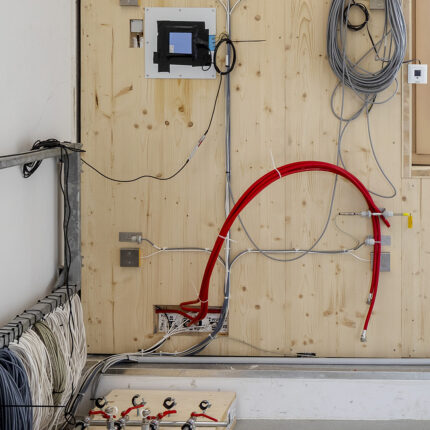
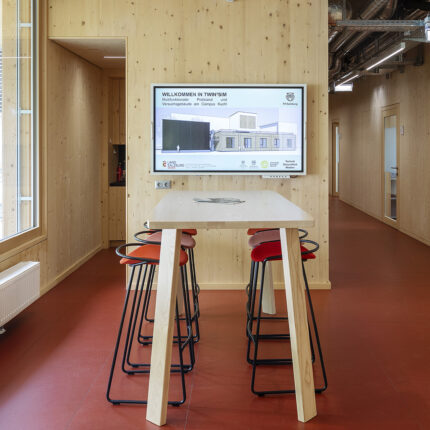
Twin²Sim is an experimental building operated by Salzburg University of Applied Sciences at the Kuchl campus. It consists of a building-envelope test rig, an experimental building, and a handling hall.
The test rig supports holistic multiphysics analysis of building envelopes and building services. Short-term investigations (3 to 9 months) at the building-envelope test rig can be combined with long-term investigations of the same prototypes in the experimental building.
The experimental building also serves as an office building and includes four test rooms and a multifunction lab. Two test rooms primarily support investigations of building services systems and their effects on people and space. In the other two test rooms, we can fully dismantle and replace the façades with units that match the dimensions used at the test rig. This allows test specimens to be examined over longer periods (several years) in interaction with space and its users.
A fifth room serves as a multifunction lab for small-scale tests and measurements on small prototypes or devices.
More information about Twin²Sim is available here:
Scientific Software
Building Physics
GEQ (energy performance certificate software)
WUFI 2D (hygrothermal simulation)
HTflux (building-physics software for high-resolution 2D simulations of heat and moisture transport)
Mechanics
Autodesk Inventor (in development)
Life Cycle Assessment
openLCA
Building Simulation
IDA Indoor Climate and Energy (IDA ICE) (detailed, dynamic, multi-zone simulations of indoor climate and whole-building energy use)
Measurement kits for capturing digital and analog signals with integration into the central measurement database
Almemo measurement devices with integration into the central measurement database
Testo measurement devices
Calibrated Fluke multimeters
Gossen calibrator for voltage, current, and resistance values
Sensors for radiation; heat flux; air, fluid, and surface temperature; air, material, and surface humidity; flow; displacement and deformation, current, and voltage
Thermal imaging cameras
Monitoring:
Detaillierte Monitoring-Systeme auch mit kundenspezifischen Regelungsstrategien
Calibration:
Wet- and dry-block calibrator for temperature sensors and the temperature sensor in combination probes
Calibration of humidity probes and humidity sensors in combination probes in climate chambers, and heat-flux sensors on a plate heater (in collaboration with the Department of Design and Green Engineering at Salzburg University of Applied Sciences)