Background
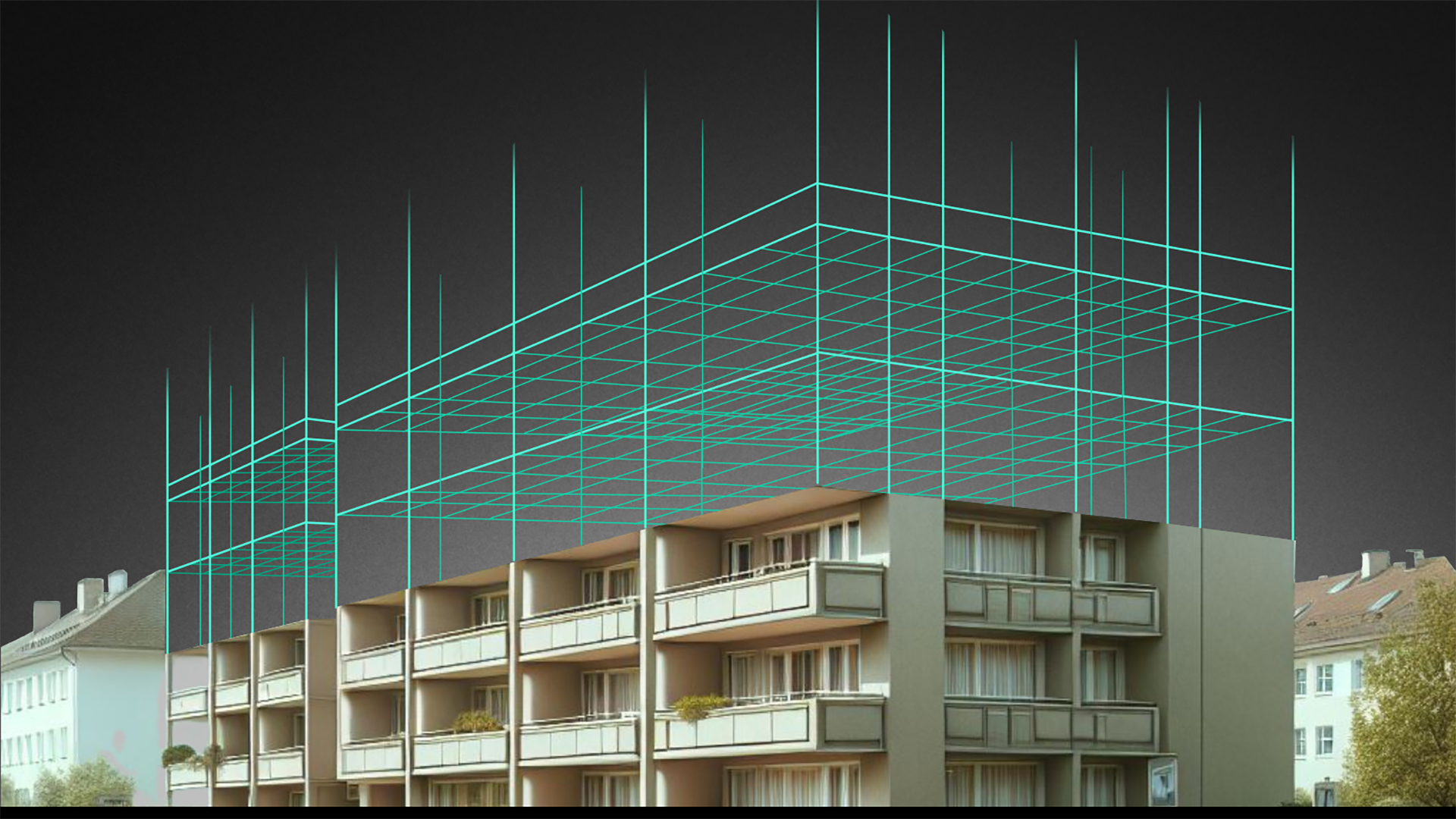
Urban densification is a central challenge for future urban development. It enables the creation of additional usable floor area without further land sealing or infrastructure expansion. In particular, residential buildings from the 1950s through the 1970s offer ideal conditions for adding stories thanks to their regular structural typologies and existing development reserves. Prefabricated timber construction is especially well suited to this task because it is a dry and fast construction method, has low dead load, and causes minimal disruption for residents. At the same time, the high level of diversity in timber construction, a lack of standards for higher building classes, and company-specific execution specifications make planning and implementation more difficult and constrain growth in the sector.
Project Objectives
LoftConcept develops structural and building-physics foundations for extending existing buildings using solid timber construction. The goal is to develop a parametric mass-timber construction system for densification in Austria and southern Germany. Digital models are intended to ensure coherence between early planning decisions and actual buildability. By linking invariantly designed detail nodes with variable building-component constructions, the project enables automated determination of performance indicators and building properties. In addition, it establishes foundations for later commercialization and transfer to other markets.
Results
The project contributes to theory building by developing standardized building blocks that reduce complexity and simplify application. By parameterizing and deriving performance characteristics of individual elements and connection details, it generates template solutions for multistory timber construction. These include approaches for typology, structural system, sound insulation, fire protection, thermal protection, and life cycle assessment. In this way, the project strengthens timber construction and promotes the sustainable use of solid timber as a building material and CO₂ sink. Industrial and timber construction companies benefit from system solutions and digital models for planning and execution, while research partners build know-how in digital modeling and parameterization.
This project is funded by the Waldfonds, an initiative of the Federal Ministry of Agriculture and Forestry, Regions and Water Management, and is carried out under the Think. Wood program of the Austrian Wood Initiative.