Background
The Salzburg State Mobility Concept 2016–2025 defines the so-called “2 plus 2 percent target.” It calls for a total mode shift of four percentage points away from motorized private transport (MIV) toward more environmentally friendly alternatives: the share of bicycle travel is to increase from about 11% to 13% (+2 percentage points), and public transport from roughly 12% to 14% (also +2 percentage points). To help achieve this “2+2” target, public transport service standards for the State of Salzburg need to be developed.
Project Objectives
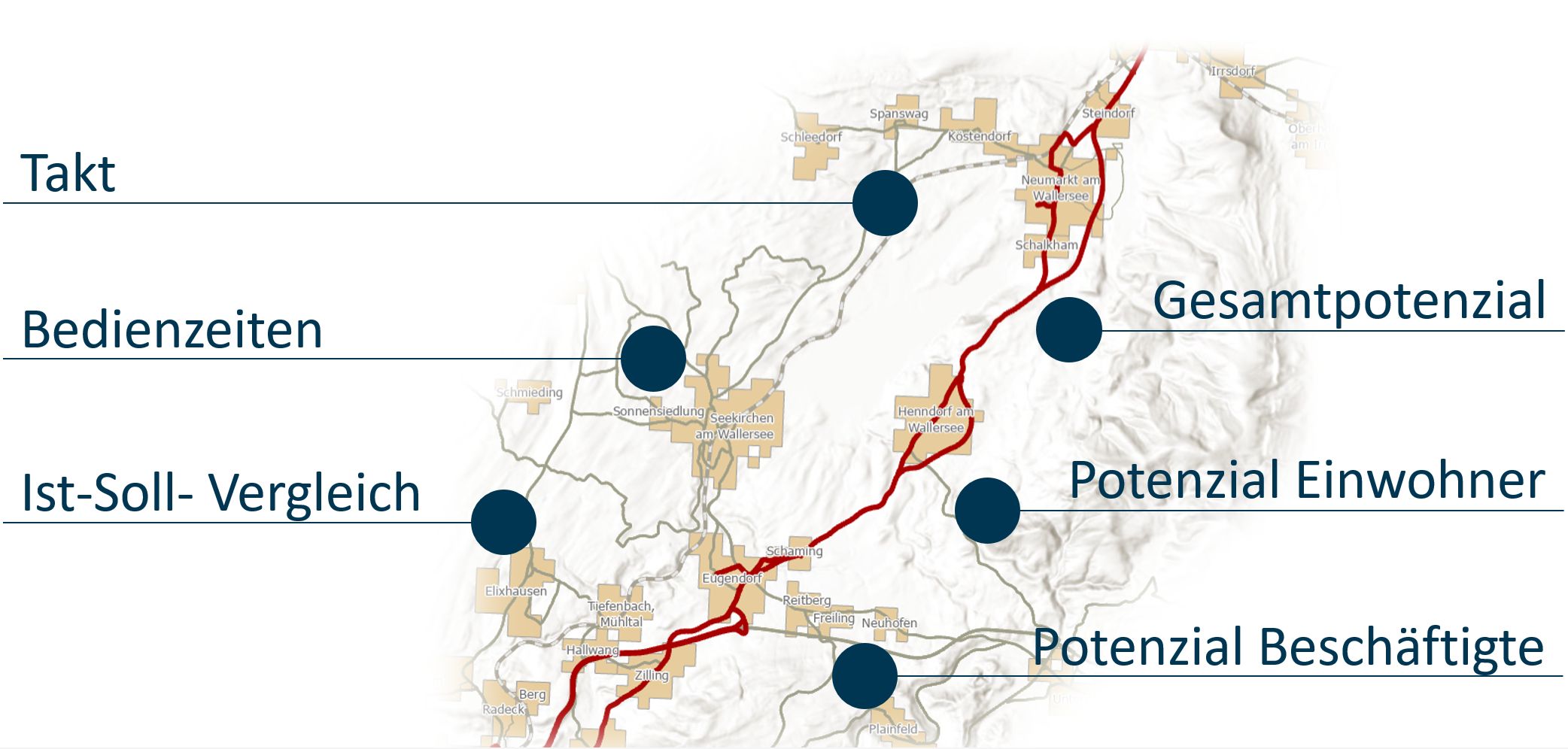
The project’s central objective is to develop the foundations for comparing the current public transport service quality of regional and interregional bus services with the target standards in the State of Salzburg, at the spatial level of corridors. To this end, spatial indicators for public transport service quality are developed and defined for each route or corridor, taking into account current planning concepts, data foundations, and technological possibilities.
In addition to evaluating data foundations and interfaces, key building blocks include the conceptual refinement and prototypical spatial modeling of selected indicators for measuring service quality.